Card machine fees explained: if you’re considering accepting card payments, understanding how card machine fees work is essential for managing business costs.
Many small business owners focus on the cost of the card reader itself, but the ongoing fees associated with taking card payments can have a much bigger impact on overall costs.
The good news is that modern payment providers have made card acceptance simpler and more transparent than ever. Most small businesses can now start accepting card payments without lengthy contracts or expensive equipment.
This guide explains the most common card machine fees, what they mean, and what to look for when comparing providers.
Not sure whether your business actually needs a card machine? Read Do I Need a Card Machine? to understand the benefits, costs, and alternatives available to UK small businesses.
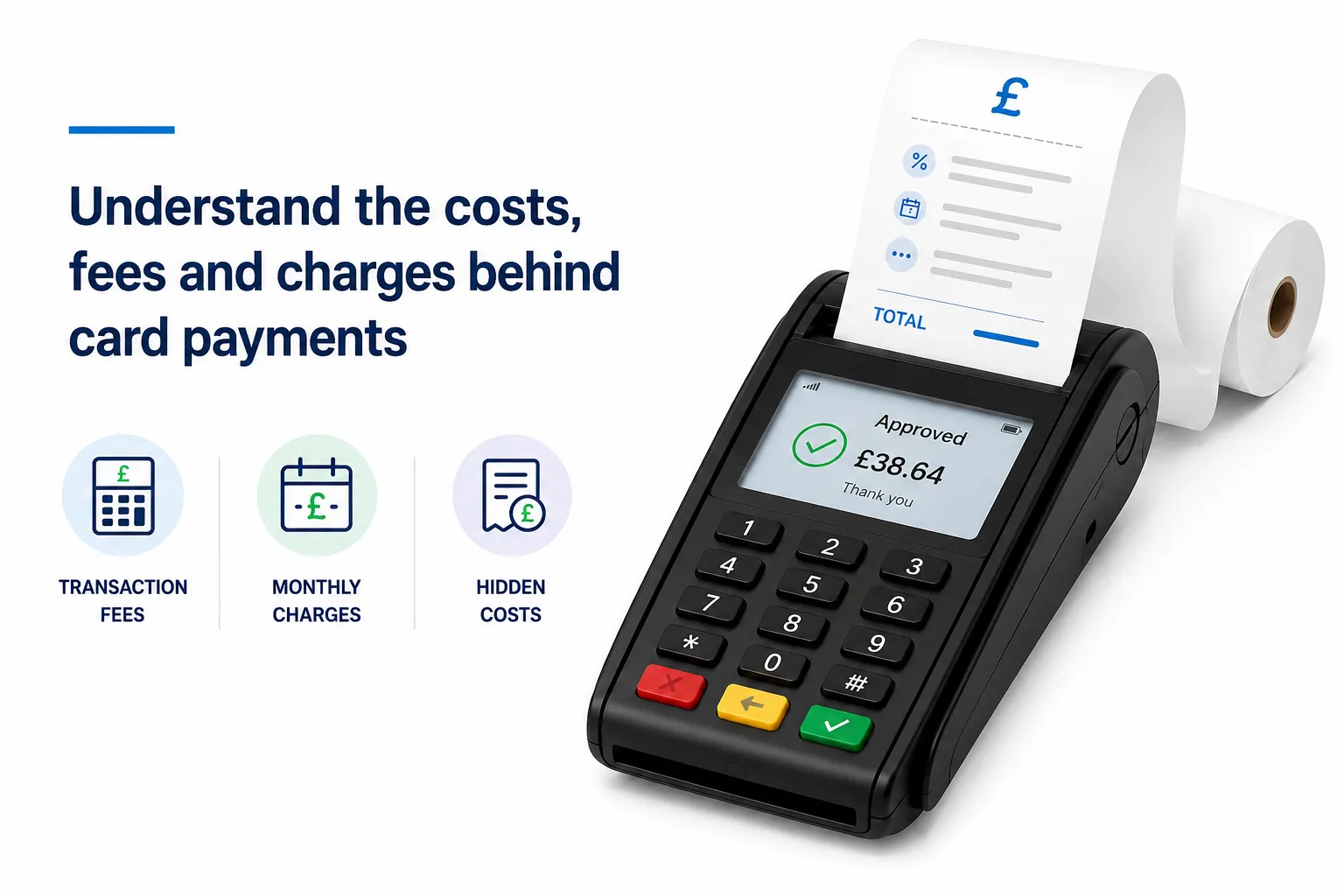
This guide explains the most common card machine fees, what they mean, and how to compare card machine fees between providers.
Quick Summary
Card machine fees typically fall into four categories:
- Transaction fees
- Monthly account fees
- Hardware costs
- Optional software subscriptions
For most UK small businesses, transaction fees have the biggest impact on long-term costs.
Want to compare actual provider costs?
What Are Card Machine Fees?
Card machine fees are the costs associated with processing card payments.
Whenever a customer pays by debit card, credit card, or contactless payment method, several parties are involved in processing the transaction. The payment provider charges fees to cover these services.
The exact fee structure varies between providers, but most businesses will encounter some combination of:
- Transaction fees
- Hardware costs
- Monthly account fees
- Optional software subscriptions
- Additional equipment costs
Understanding these charges can help you choose the right payment solution for your business.
Common Types of Card Machine Fees
Transaction Fees
Transaction fees are charged whenever a customer makes a card payment.
These fees are usually calculated as a percentage of each transaction, although some providers may use alternative pricing structures.
For businesses processing a high volume of card payments, transaction fees often become the largest ongoing cost.
When comparing providers, it’s important to consider your expected sales volume rather than focusing solely on the initial cost of the card reader.
💡 Want Real Pricing Examples?
For real-world examples, see our detailed guides to SumUp Fees UK, Square Fees UK, Zettle Fees UK and Dojo Fees UK which break down transaction costs, hardware pricing and subscription plans for two of the UK’s most popular providers.
Card Reader Purchase Costs
Most modern card readers are purchased outright rather than rented.
The upfront cost is usually a one-time expense and allows businesses to start accepting payments without entering a long-term agreement.
For many small businesses, buying a card reader outright provides greater flexibility than traditional rental agreements.
For examples of affordable devices, see our guide to Cheapest Card Readers UK.
Monthly Account Fees
Some providers charge a monthly fee for access to payment processing services, reporting tools, or point-of-sale features.
Other providers operate without fixed monthly charges, making them attractive for businesses with lower transaction volumes.
Whether a monthly fee represents good value depends on the features included and the size of your business.
Software Subscription Fees
Many payment providers offer additional software products designed to help businesses manage operations.
Examples may include:
- Inventory management
- Customer databases
- Appointment booking
- Staff management
- Advanced reporting
These subscriptions are often optional, but they can increase overall costs if your business requires additional functionality.
Additional Equipment Costs
Depending on your setup, you may choose to purchase extra accessories such as:
- Charging docks
- Receipt printers
- Tablet stands
- Cash drawers
- Barcode scanners
These costs are usually optional but may be necessary for retail or hospitality environments.
Factors That Affect Your Overall Costs
Transaction Volume
Businesses that process more card payments will naturally pay more in transaction-related fees.
However, higher-volume businesses may benefit from solutions that offer more advanced features and efficiencies.
Average Transaction Value
The size of your typical customer transaction can also influence the overall cost of accepting payments.
Businesses selling higher-value products may evaluate providers differently from businesses processing large numbers of small transactions.
Business Type
The ideal payment solution often depends on how you operate.
For example:
📱 Viewing on mobile? Swipe left and right to see the full table.
| Sole Trader | Low-cost, portable card reader |
| Market Trader | Mobile payments and portability |
| Retail Shop | Stock management and reporting |
| Café or Restaurant | Faster checkout and POS integration |
| Service Business | Mobile payments and invoicing |
Are Contract-Free Card Readers Cheaper?
For many small businesses, contract-free payment solutions provide excellent value.
Benefits often include:
- Lower upfront commitment
- Greater flexibility
- Easier switching between providers
- No long-term rental agreements
However, the cheapest solution depends on your transaction volume, required features, and long-term business goals.
How to Compare Card Machine Providers
When comparing providers, consider the following:
Upfront Costs
What does the card reader cost to purchase?
Ongoing Costs
What fees apply when you process payments?
Contract Requirements
Are you tied into a long-term agreement?
Business Features
Does the platform offer tools that could save time or improve efficiency?
Customer Support
Is support available when you need help?
Comparing providers based on total value rather than a single fee often leads to a better long-term decision.
⚖️ Comparing Providers?
For a broader comparison of available options, see our guide to Best Card Payment Machines UK.
If you’re deciding between popular providers, read our detailed Square vs SumUp UK, Square vs Zettle UK, Square vs Dojo UK and SumUp vs Zettle UK comparison guides for a detailed breakdown of how their fees compare in practice.
Ways to Reduce Card Machine Fees
While some fees are unavoidable, businesses can often reduce costs by:
- Choosing a provider that matches their transaction volume
- Avoiding unnecessary software subscriptions
- Purchasing only essential accessories
- Reviewing payment costs regularly
- Comparing providers before committing
A small amount of research can lead to significant savings over time.
Card Machine Fees for UK Small Businesses: Final Verdict
For most UK small businesses, transaction fees are the most important cost to compare because they continue long after the initial hardware purchase.
Before choosing a provider, compare both upfront costs and ongoing charges to understand the true cost of accepting card payments.
For a complete comparison of leading options, visit our guides to:
Frequently Asked Questions
Do all card machines charge transaction fees?
Most payment providers charge some form of transaction fee whenever a card payment is processed.
Are there card machines with no monthly fees?
Yes. Some providers offer solutions that do not require fixed monthly account charges.
Is buying a card reader cheaper than renting one?
For many small businesses, purchasing a card reader outright is often more cost-effective than entering a long-term rental agreement.
What is the biggest card machine cost?
For businesses taking regular card payments, transaction fees are often the most significant ongoing expense.
Can I change card payment providers later?
Many modern payment solutions are contract-free, making it easier to switch providers if your needs change.
Related Guides
SumUp Fees UK?
Understand SumUp’s transaction fees, card reader costs and optional subscription plans.
Read Guide →Square Fees UK?
Explore Square’s transaction fees, hardware pricing and POS software subscription costs.
Read Guide →Zettle Fees UK?
See our complete breakdown of Zettle pricing, transaction fees, hardware costs and PayPal Point of Sale features.
Read Guide →Square vs Zettle UK?
Compare Square and Zettle side-by-side, including fees, hardware, software and business suitability.
Read Guide →Square vs Dojo UK
Compare Square and Dojo on fees, hardware, software, reporting and overall value to find the best card payment provider for your business.
Read Guide →Best Card Payment Machines UK
Before choosing a provider, understand the fees and costs involved in accepting card payments.
Read Guide →Cheapest Card Readers UK
Compare transaction fees, monthly charges and hidden costs to find the true cheapest option.
Read Guide →Learn More About Payment Processing
If you’d like to understand how electronic payments work in the UK, useful information is available from UK Finance, the Financial Conduct Authority (FCA), and GOV.UK.
- UK Finance provides information on how card payments are processed in the UK.
- Businesses can also find guidance on payment services from the Financial Conduct Authority (FCA)
- New businesses can find general guidance on accepting payments and running a business through GOV.UK.